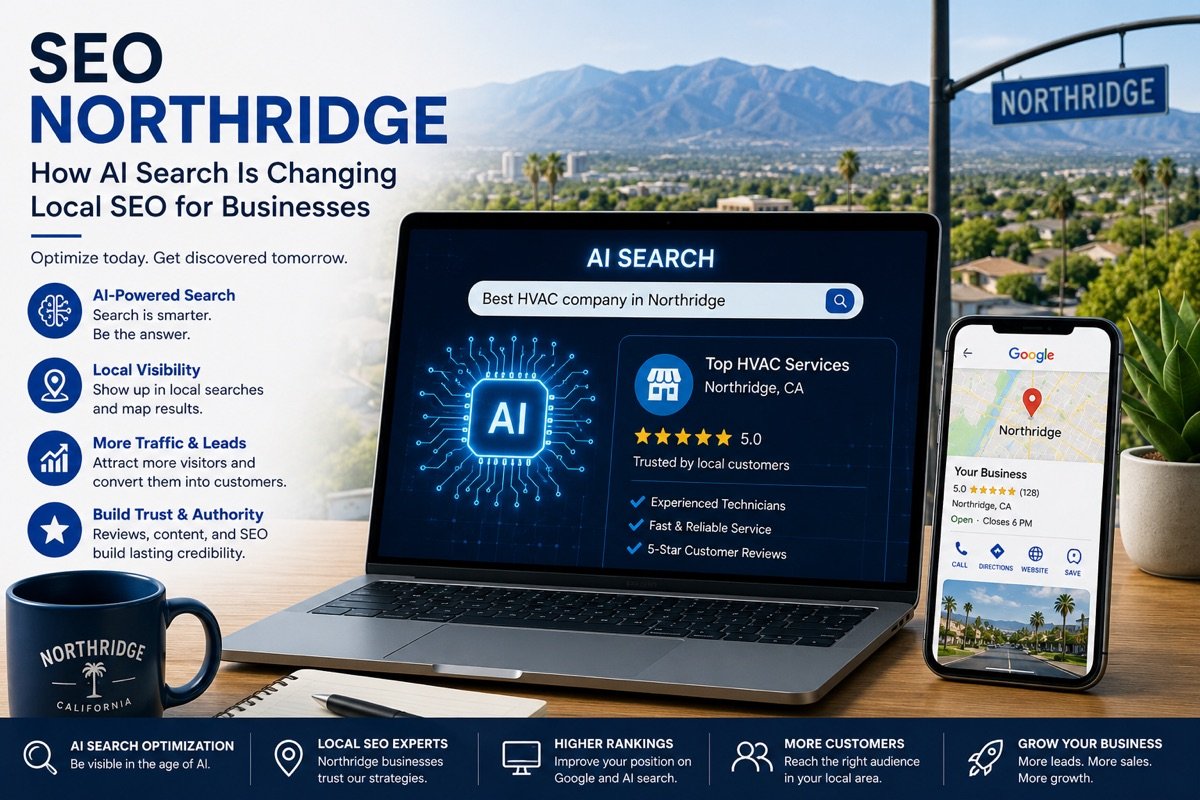
A customer in Porter Ranch who once typed two words into a search box may now type a whole question. On some searches, an AI search summary then appears before any list of links. That shift has produced plenty of confident, contradictory predictions. Yet nobody outside the search companies knows exactly how these AI answers choose which businesses to mention, so anyone claiming precise figures is guessing. What can be said is which habits still pay off for a Northridge business, which ones matter more than before, and which popular claims do not hold up. This post takes those claims one at a time.
What has actually shifted in AI search
The clearest change is phrasing. People increasingly search the way they would ask a neighbor. Suggestion data for this area includes full questions such as “do i need a lawyer for probate,” “cpa vs accountant vs bookkeeper” and “is solar worth it in 2026.” Each is someone trying to understand a situation before calling anyone. Any AI search tool that writes a summary for that person has to draw on pages and listings that state facts clearly. By contrast, a business whose details are vague, contradictory or buried in a PDF gives it little to work with.
Six common AI search claims, checked
Claim: keywords no longer matter
What holds up: words still matter, but as the natural phrasing of real questions. The research behind this site found that word order made the difference. For example, the phrase “best restaurants in northridge ca” returns suggestion after suggestion, while “seo company northridge” returns nothing. So pages written the way people genuinely speak, with the CA on the end, match far more searches than stiff keyword strings ever did.
Claim: your Google Business Profile matters less now
What holds up: if anything, the profile is more exposed. Its hours, categories and listed services are the structured facts any summary can quote. Google says its local rankings rest on relevance, distance and prominence. Nothing about a new interface removes the need for accurate data under it. After all, a profile showing the wrong hours sends a customer to a locked door, whether they found you through a map, a list or a paragraph.
Claim: there is a special trick for getting into AI search answers
What holds up: be cautious of anyone selling guaranteed placement. Nobody controls Google’s index, and rankings already vary by the searcher’s location, device and time of day. In fact, Google’s own guidance on AI features and your website describes no special markup for them. The dependable work is the same work that earns ordinary visibility: complete information, steady reviews and a page for each real question.
Claim: adding FAQ markup will win you a special result
What holds up: Google restricted FAQ rich results to government and health sites in 2023, so a commercial site should not expect an expandable snippet. Structured data is still worth adding, because answer engines and AI search tools parse it. Think of it, then, as labeling your facts for machines rather than decorating your search result.
Claim: a machine will work out where you serve on its own
What holds up: not necessarily. Locals describe this area by its landmarks, so your pages should too. Writing “Northridge, CA” and naming real anchors nearby, such as CSUN, Nordhoff Street, Reseda Boulevard, Granada Hills and Porter Ranch, tells both people and software exactly which streets you serve. Education businesses feel this most, as the SEO guide for tutors and schools near CSUN explains.
Claim: generic content written for robots is enough
What holds up: generic pages match nothing. The searches that bring in customers are specific: by problem, by price, by urgency. For instance, a law firm that plainly answers whether someone needs an attorney for a will gives a summary something worth repeating, even when the honest answer is probably not. Our page on SEO for law firms fielding probate and will questions shows that approach in detail.
What stays exactly as it was
- Distance still counts. A customer in Chatsworth will usually be shown businesses near Chatsworth, however the results are presented.
- Reviews still persuade. Recency matters as much as the star rating, and replying to reviews remains a ranking signal.
- Consistency still builds trust. The business name, street address and phone line should read identically across the website, Google and every directory.
- Speed and mobile layout still matter. Most local searches happen on a phone, often over cellular.
The profile side of this is covered on our page on optimizing your Google Business Profile for the map pack, and the site side on our page about website design built so search engines can read it.
A short AI search audit to run this week
- On your phone, ask a full question a customer might ask about your trade. Then note who appears and which facts the results show about them.
- Open your own profile and confirm the primary category, each service as its own entry, and hours including holidays.
- Line up the name, street address and phone line shown on your website, Google, Yelp and any trade directory. Fix every mismatch.
- Check that “Northridge, CA” and at least one nearby landmark appear naturally on your main pages.
- Pick the three questions customers ask you most and make sure each has a clear written answer on your site, ideally with a price range.
None of these steps depends on predicting where AI search goes next. That is exactly why they are safe to do now. For shorter answers on timelines and costs, see our frequently asked SEO questions. For an outside view of how your business shows up today, ask for a free SEO audit; the findings come back in plain English.